Luxonis M8 Box: An RP2040 That Wires Edge AI to Machines
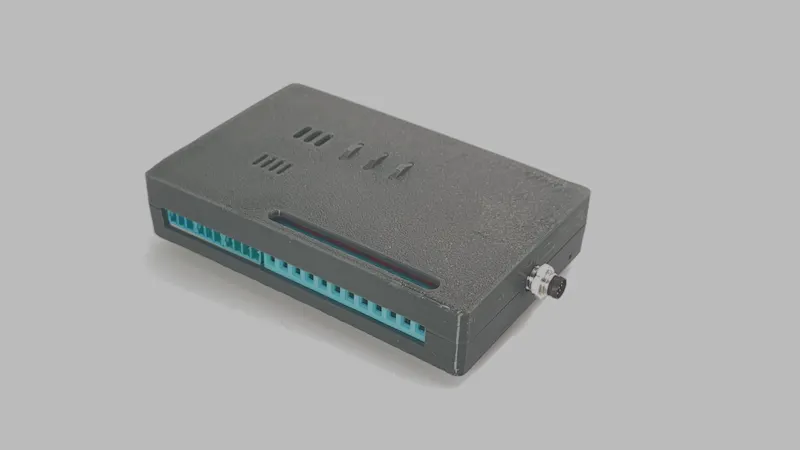
Edge AI cameras have gotten scary good at the seeing part. They spot a cracked casting, read a barcode, or count parts on a conveyor without ever phoning a server. The awkward gap has always been the doing part: once the camera decides something, you usually bolt on a PC or a PLC just to flip a relay. A wave of hardware is now closing that gap by putting perception and physical control on the same board, and Luxonis' new M8 Controller Box is a clean example of where that trend is heading.
What the M8 Box actually is
The M8 Box plugs straight into a Luxonis OAK4 vision camera through its M8 connector and hands the camera real-world outputs: GPIOs, relays, a CAN bus, serial, and USB. That means the vision pipeline running on the camera can throw a relay or send a CAN frame the instant it recognizes something, with no intermediary computer in the loop. Luxonis is shipping it as a $249 prototype kit with the box, an M8 cable, DIN rail hardware, and screw terminals.
Here is the part that should catch a microcontroller nerd's eye: the whole I/O layer is run by a Raspberry Pi RP2040, the same dual Cortex-M0+ chip you find on a Pico. It runs at 133 MHz with 264 KB of SRAM and pulls its 5 V straight from the OAK4 camera, so there is no separate power brick to wire.
The specs worth knowing
Inside the 123 x 78 x 29 mm case you get 16 protected 3.3 V GPIOs, four heavy SPDT latching relays rated to 16 A at 400 VAC, RS232, and CAN 2.0A/2.0B running up to 1 Mbps. Two 3.3 V rails can feed external sensors at a combined 450 mA. The peripherals talk over the u2if (USB-to-interfaces) protocol, and you drive everything from the camera using the oakctl command-line tool. Luxonis' open-source oak-examples repo already has demos for relay switching, GPIO control, CAN, audio, and barcode detection, so you are not starting from a blank sketch.
What to try next
You do not need a $249 industrial box to chase this idea. Grab a Raspberry Pi Pico, wire a relay module to a GPIO through a transistor, and have a small vision model on an ESP32-CAM or a Pi trigger it over serial. That is the same perception-to-action loop the M8 Box sells, just at student-budget scale, and it is a strong capstone build for anyone eyeing machine vision. Read the full breakdown on Hackster, then decide whether your next robotics project really needs that extra PLC.
Originally published on blog.circuit.rocks.
#edgeai #tinyml #machinelearning #ai #embedded #robotics #robots #circuitrocks
About the author
- ⚡ Distributor of Open-Source Hardware 📍 Since 2015 | Metro Manila, PH 🔧 Empowering makers, students & innovators
Comments
Join the discussionNo comments yet. Be the first to comment.


